Written by
Jennifer Macmillan, Collections Systems Specialist
Nic Regan, Systems Support Specialist
Last year, we wrote to you at the beginning of our journey as a pilot museum for the sensational museum project. A year later, we’ve wrapped up this project and are taking several aspects forward into our day-to-day work.
Read the previous blog from the BFI team
The Sensational Museum is an interdisciplinary research project rethinking the role of senses in museums, looking at how to make the museum experience less sight-centric – using what we know about disability to change how museums work for everyone.
Strand A of the project reimagined how Collections Management Systems, like Axiell Collections, deal with data. We tested multi-sensory ways of working with collections records, using prototype resources and tools, gave feedback on how they work and how they fit with existing working practices and promote new ones.
What did this look like in practical terms? In the prototype system, Jennifer and Nic identified digitised items from our collection – TV episodes, photograph stills, costume designs – and sat with them (virtually), cataloguing not only their immediate sense-based observations, such as what the item felt like, looked like or smelt like, but also their own personal sense-based reactions. This could be as straightforward as a scene in a TV episode evoking a childhood memory, or as complex as thinking about the time-based sensory implications of using ink to draw a design, or how it would feel to wear the design of a heavy fur cloak under stage lights in a film production. We spent three months working in a really slow, deliberate fashion with individual items, recording this sensory data and working with the system.
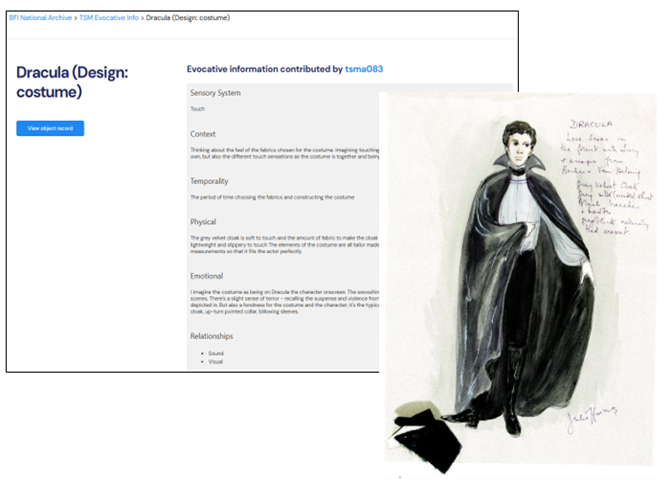
Here we thought about the senses evoked by working with this item, a costume design for the movie Dracula (signed by the artist Julie Harris, 1979).
In terms of the prototype system itself, it was a fairly basic web-based platform – not a software product destined for the market, more a space to consider what is possible in multi-sensory system design and collections data capture. One area we really liked and weren’t necessarily expecting was the area set aside to describe our collections locations. We were encouraged to think of locations both physical and digital, and describe them in quite granular detail. While we might think about recording the temperature of our locations in our own database – for instance, our nitrate holding locations are kept at very low temperatures – we’ve never captured much accessibility data beyond that. Could, and equally should, we capture more descriptive data in our Locations database, like: is it a step free space, are there tables and seating, is there wi-fi access, what are the noise levels? Being challenged to think about providing much more holistic accessibility data about our locations helped us rethink how the system can serve us and our users better.
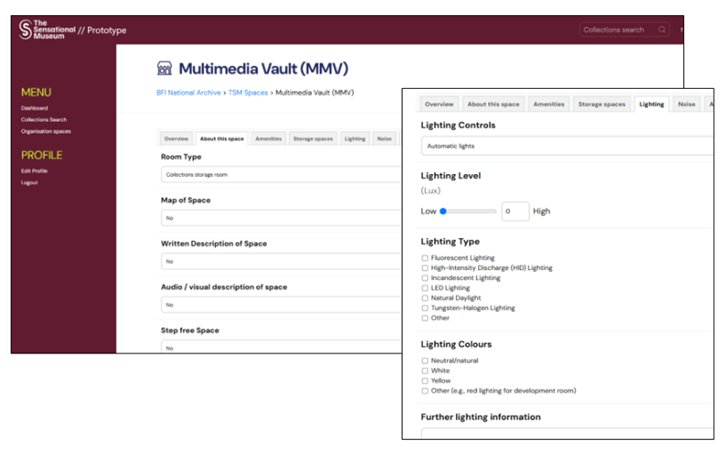
The Spaces section of the prototype encouraged us to think about access in a much more granular fashion than we had before!
Now that the project has wrapped up, we’re going to be looking at how we can integrate collecting sensory data and access data into our Axiell Collections database. We’ll begin with some access audits of our physical locations, and from there start thinking about how to record this data in our locations database.
If you want to try some multi-sensory cataloguing, or thinking about your database this way, try these prompts:
- What information beyond the location name do you want to know about where an item is? Is it useful to know if an item is on a high shelf, or if that store has ladders available?
- Where in your current processes are you already gathering sense-based data? When are you thinking about how an object smells, feels or sounds? Is there somewhere in your object record you can collate that data in one place?
- If you were describing an item to someone without using visual references, what would you say? Examine how it would feel to use or interact with the object.
- What does it remind you of?